Share Elizabeth C. Hsu's obituary with others.
Invite friends and family to read the obituary and add memories.
Stay updated
We'll notify you when service details or new memories are added.
You're now following this obituary
We'll email you when there are updates.
Select your format and elements to print

1920
Elizabeth
2023


Elizabeth C. Hsu
Apr 22, 1920 — Oct 19, 2023
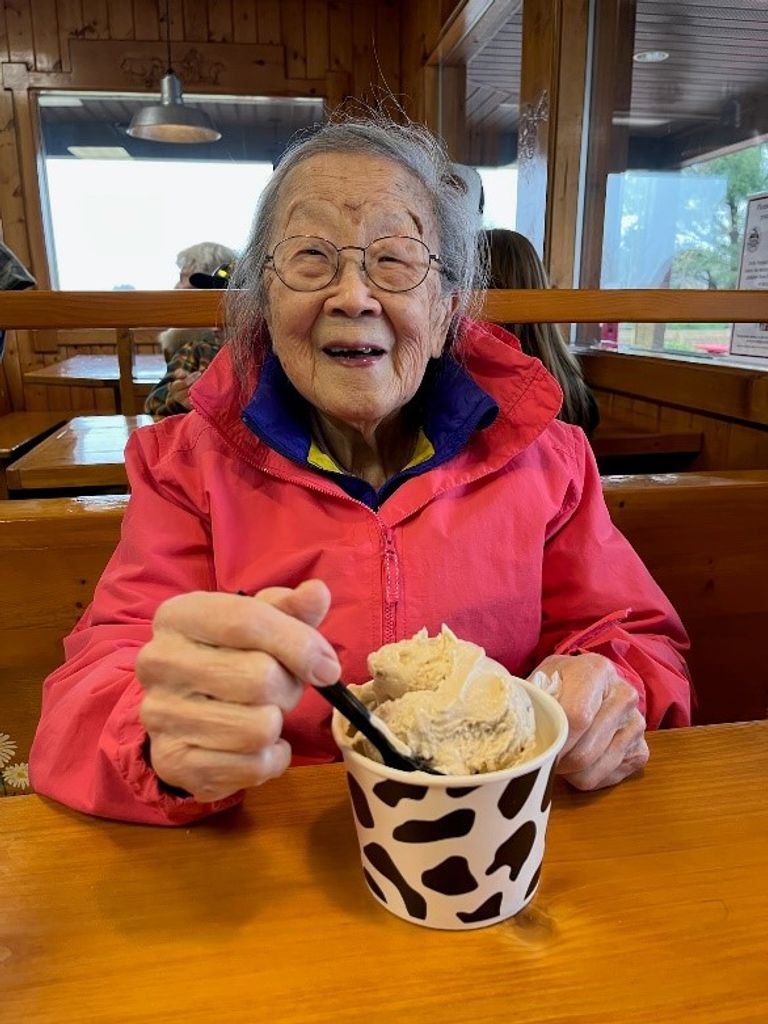
Elizabeth C. Hsu, 103, of Traverse City passed away peacefully in the comfort of her family's home on Thursday, October 19, 2023.
Born on April 22, 1920 in Datong, China to the late Mung-Fu and Tsai-Tsao (Yang) Chang, Elizabeth's childhood years were spent in rural Yantai in China's northeastern Shandong Province. Her paternal grandfather, a devout follower of Taoist teachings, wrote a prophecy which foresaw for Elizabeth a long, productive life during which she would live somewhere far away from China. Elizabeth's mother, newly converted to Christianity, cautioned her to disregard "provincial superstitions" and instead to get ahead in life by studying and working hard. To this end, at age 10, Elizabeth was enrolled in fifth grade at Bridgeman Academy, a girls' boarding school founded by American Christian missionaries in Beijing, a two-day, 450-mile journey from home via train and boat, where her older sister Esther, a high-school student at Bridgeman, would be her chaperone and mentor. Upon Esther's graduation two years later, Elizabeth learned to live independently at boarding school from age 12 through the rest of her pre-college years. Some of her happiest life memories came from her life and friendships at Bridgeman.
When Elizabeth started college in 1938, China was at war with Japan, which in 1937 had invaded and begun to occupy large Chinese cities, among them Beijing and Shanghai. Elizabeth's college moved into the countryside of Western China, not only to avoid the ground fighting, but also to avoid Japanese bombing raids which frequently targeted civilians. This Sino-Japanese War eventually blended into the Asian Theatre of World War II, and has been referred to as the "Asian Holocaust" because of the scale of Japan's war crimes against Chinese civilians. Japan's capture of Nanjing in 1937, memorialized as the "Rape of Nanjing," resulted in the murders of between 200,000 to 300,000 mostly civilians in a city undefended by trained military personnel. Sometimes hiding in air-raid shelters in mountain caves, once emerging to find her dorm had been bombed and her possessions lost, Elizabeth reminisced fondly about old friendships formed through shared adversity and common purpose.
After college and dental school, Elizabeth secured a teaching position at the Dental School of National Central University in Nanjing. Now a groundbreaking female Chinese dentist, she married in 1946 shortly after the end of World War II. A peaceful life remained out of reach. With the defeat of Japan, the Chinese Communists and Nationalists resumed their Civil War which had begun in 1927 but had been placed on hold while the two sides briefly united to fight Japan.
Following the end of World War II, the Communists got the upper hand early on and captured most of northern China. Elizabeth's home province of Shandong was in the north and her parents still lived there although Elizabeth and her husband John and two children lived further south in Nanjing, the capital of China. Elizabeth's mother did not want to live under Communism, having witnessed their persecution of the middle class with which she identified. Although she had grown up at a time when girls in China did not attend school and she had no formal education, Elizabeth's mother had learned to read from male family members and astutely foresaw that China would soon come under Communist control. She advocated for her family to move off the Chinese mainland either to Taiwan or Hong Kong. Both sanctuaries had their advantages and disadvantages. She decided on Taiwan, where the Nationalist government had already fled. Her travel family of six would consist of her husband, herself, and Elizabeth's family of four. They met together in Shanghai, preparing to sail for Taiwan, an island over 400 miles away, aboard the steamship Tai Ping Lun on January 26, 1949. On the day of departure, Elizabeth's mother had a change of heart and decided to go to Hong Kong instead. Their tickets were returned and immediately snapped up by others eager for passage. Meanwhile, the ship, grossly overloaded with cargo and refugees, was delayed leaving the harbor, thereby missing a Communist-imposed departure deadline of 11:00 p.m. The ship sneaked out of the harbor after the curfew deadline, making itself invisible to port authorities by sailing with no lights. It was also invisible to the crew of the Chienyuen, a cargo ship which collided with the Tai Ping Lun, killing all but 40 of the estimated 1,600 occupants of both ships. Elizabeth's sister Esther, having emigrated to America with her husband 2 ½ years earlier, was in New York City's Chinatown when she saw a Chinese-language newspaper about the Tai Ping Lun tragedy. Assuming that she had just lost her entire family, Esther had a nervous breakdown and spent two weeks in a hospital psychiatric ward. Two weeks after leaving the hospital Esther received a letter from Elizabeth that all was well. Due to their mother's change of heart, they had missed the Tai Ping Lun's final voyage.
Shortly afterwards, Elizabeth's mother decided they should go to Taiwan after all. This time the journey was uneventful. With Esther's urging, Elizabeth's family including her parents decided to try to emigrate to the U.S. The American immigration policy at that time was a quota system where a different maximum number of immigrants per year was allowed from each country. European countries were favored with high quotas, such as 10,000 for each of France and Italy. China's quota was only 105, and Elizabeth's family would be applying for 6 of these openings. Somehow, this application succeeded, although the family of 6 had to immigrate in 2 different years, Elizabeth and her 2 children in 1952, and Elizabeth's husband and parents in 1954.
American regulations prevented Elizabeth, as a foreign dental graduate, from practicing dentistry unless she repeated dental school in the U.S. Elizabeth chose not to repeat dental school but did return to college, expanding her horizons by getting a Bachelor's Degree in education and a Master's Degree in counselling. She then worked as a psychiatric social worker alongside her psychiatrist husband in addition to raising her now-larger family of 5 children. At age 60 she returned to China for several months to learn acupuncture. Incorporating acupuncture with her counselling skills enabled a creatively holistic approach which was successful for some conditions which had resisted previous standard treatment.
Elizabeth maintained a lifelong devotion to her Savior and to her Church, serving in the historic 1957 Billy Graham Crusade Choir in New York City. In later years she opened her own home for weekly Bible study, worship, and prayer meetings.
As her children grew up and left home and her family elders aged, Elizabeth became the caretaker for each of her parents, her husband, and her sister Esther over a 25-year period. Conscientiously caring for each of them in turn in her home, none of them were institutionalized as they slowly declined.
That love was returned to Elizabeth in her later years as she lived with her son and daughter-in-law, and every Sunday for 3 ½ years she kept in touch via Zoom with her children and grandchildren scattered across the United States and Canada. Throughout her life, her Christian faith remained a pillar of her strength, yet she couldn't help but wonder about her Taoist grandfather's prescience, "I wish I still had his prophecy for me. I'd like to remember what I've left undone!"
Elizabeth is survived by her 5 children James (Mary Jane), Nancy, Timothy (Beth), Hwayling (Jeffrey Enzminger), John R. (San), 10 grandchildren, and 4 great-grandchildren.
She is preceded in death by her parents, her husband John J., and her sister Esther.
Private family services will be held at a later time. Her family is being cared for by the Reynolds-Jonkhoff Funeral Home.
Born on April 22, 1920 in Datong, China to the late Mung-Fu and Tsai-Tsao (Yang) Chang, Elizabeth's childhood years were spent in rural Yantai in China's northeastern Shandong Province. Her paternal grandfather, a devout follower of Taoist teachings, wrote a prophecy which foresaw for Elizabeth a long, productive life during which she would live somewhere far away from China. Elizabeth's mother, newly converted to Christianity, cautioned her to disregard "provincial superstitions" and instead to get ahead in life by studying and working hard. To this end, at age 10, Elizabeth was enrolled in fifth grade at Bridgeman Academy, a girls' boarding school founded by American Christian missionaries in Beijing, a two-day, 450-mile journey from home via train and boat, where her older sister Esther, a high-school student at Bridgeman, would be her chaperone and mentor. Upon Esther's graduation two years later, Elizabeth learned to live independently at boarding school from age 12 through the rest of her pre-college years. Some of her happiest life memories came from her life and friendships at Bridgeman.
When Elizabeth started college in 1938, China was at war with Japan, which in 1937 had invaded and begun to occupy large Chinese cities, among them Beijing and Shanghai. Elizabeth's college moved into the countryside of Western China, not only to avoid the ground fighting, but also to avoid Japanese bombing raids which frequently targeted civilians. This Sino-Japanese War eventually blended into the Asian Theatre of World War II, and has been referred to as the "Asian Holocaust" because of the scale of Japan's war crimes against Chinese civilians. Japan's capture of Nanjing in 1937, memorialized as the "Rape of Nanjing," resulted in the murders of between 200,000 to 300,000 mostly civilians in a city undefended by trained military personnel. Sometimes hiding in air-raid shelters in mountain caves, once emerging to find her dorm had been bombed and her possessions lost, Elizabeth reminisced fondly about old friendships formed through shared adversity and common purpose.
After college and dental school, Elizabeth secured a teaching position at the Dental School of National Central University in Nanjing. Now a groundbreaking female Chinese dentist, she married in 1946 shortly after the end of World War II. A peaceful life remained out of reach. With the defeat of Japan, the Chinese Communists and Nationalists resumed their Civil War which had begun in 1927 but had been placed on hold while the two sides briefly united to fight Japan.
Following the end of World War II, the Communists got the upper hand early on and captured most of northern China. Elizabeth's home province of Shandong was in the north and her parents still lived there although Elizabeth and her husband John and two children lived further south in Nanjing, the capital of China. Elizabeth's mother did not want to live under Communism, having witnessed their persecution of the middle class with which she identified. Although she had grown up at a time when girls in China did not attend school and she had no formal education, Elizabeth's mother had learned to read from male family members and astutely foresaw that China would soon come under Communist control. She advocated for her family to move off the Chinese mainland either to Taiwan or Hong Kong. Both sanctuaries had their advantages and disadvantages. She decided on Taiwan, where the Nationalist government had already fled. Her travel family of six would consist of her husband, herself, and Elizabeth's family of four. They met together in Shanghai, preparing to sail for Taiwan, an island over 400 miles away, aboard the steamship Tai Ping Lun on January 26, 1949. On the day of departure, Elizabeth's mother had a change of heart and decided to go to Hong Kong instead. Their tickets were returned and immediately snapped up by others eager for passage. Meanwhile, the ship, grossly overloaded with cargo and refugees, was delayed leaving the harbor, thereby missing a Communist-imposed departure deadline of 11:00 p.m. The ship sneaked out of the harbor after the curfew deadline, making itself invisible to port authorities by sailing with no lights. It was also invisible to the crew of the Chienyuen, a cargo ship which collided with the Tai Ping Lun, killing all but 40 of the estimated 1,600 occupants of both ships. Elizabeth's sister Esther, having emigrated to America with her husband 2 ½ years earlier, was in New York City's Chinatown when she saw a Chinese-language newspaper about the Tai Ping Lun tragedy. Assuming that she had just lost her entire family, Esther had a nervous breakdown and spent two weeks in a hospital psychiatric ward. Two weeks after leaving the hospital Esther received a letter from Elizabeth that all was well. Due to their mother's change of heart, they had missed the Tai Ping Lun's final voyage.
Shortly afterwards, Elizabeth's mother decided they should go to Taiwan after all. This time the journey was uneventful. With Esther's urging, Elizabeth's family including her parents decided to try to emigrate to the U.S. The American immigration policy at that time was a quota system where a different maximum number of immigrants per year was allowed from each country. European countries were favored with high quotas, such as 10,000 for each of France and Italy. China's quota was only 105, and Elizabeth's family would be applying for 6 of these openings. Somehow, this application succeeded, although the family of 6 had to immigrate in 2 different years, Elizabeth and her 2 children in 1952, and Elizabeth's husband and parents in 1954.
American regulations prevented Elizabeth, as a foreign dental graduate, from practicing dentistry unless she repeated dental school in the U.S. Elizabeth chose not to repeat dental school but did return to college, expanding her horizons by getting a Bachelor's Degree in education and a Master's Degree in counselling. She then worked as a psychiatric social worker alongside her psychiatrist husband in addition to raising her now-larger family of 5 children. At age 60 she returned to China for several months to learn acupuncture. Incorporating acupuncture with her counselling skills enabled a creatively holistic approach which was successful for some conditions which had resisted previous standard treatment.
Elizabeth maintained a lifelong devotion to her Savior and to her Church, serving in the historic 1957 Billy Graham Crusade Choir in New York City. In later years she opened her own home for weekly Bible study, worship, and prayer meetings.
As her children grew up and left home and her family elders aged, Elizabeth became the caretaker for each of her parents, her husband, and her sister Esther over a 25-year period. Conscientiously caring for each of them in turn in her home, none of them were institutionalized as they slowly declined.
That love was returned to Elizabeth in her later years as she lived with her son and daughter-in-law, and every Sunday for 3 ½ years she kept in touch via Zoom with her children and grandchildren scattered across the United States and Canada. Throughout her life, her Christian faith remained a pillar of her strength, yet she couldn't help but wonder about her Taoist grandfather's prescience, "I wish I still had his prophecy for me. I'd like to remember what I've left undone!"
Elizabeth is survived by her 5 children James (Mary Jane), Nancy, Timothy (Beth), Hwayling (Jeffrey Enzminger), John R. (San), 10 grandchildren, and 4 great-grandchildren.
She is preceded in death by her parents, her husband John J., and her sister Esther.
Private family services will be held at a later time. Her family is being cared for by the Reynolds-Jonkhoff Funeral Home.
To plant a memorial tree in memory, please visit our tree store.
Guestbook
This site is protected by reCAPTCHA and the
Google Privacy Policy and Terms of Service apply.
Service map data © OpenStreetMap contributors